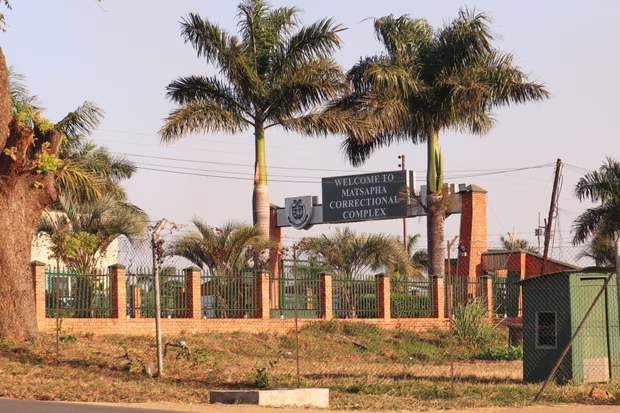
The government of Eswatini announced on Thursday that it had accepted four additional deportees transferred from the United States under a bilateral arrangement that allows the country to receive individuals who are not its own citizens.
With the latest arrivals, a total of 19 people deported from the U.S. have been sent to Eswatini despite originating from other countries. The transfers come amid broader immigration enforcement measures introduced during the administration of Donald Trump.
The flight carrying the latest group was identified through an aircraft tracking system maintained by the advocacy organization Human Rights First, which monitors flights linked to deportations conducted by U.S. Immigration and Customs Enforcement. According to the tracker, the plane departed from Phoenix in the state of Arizona and landed in Eswatini late Wednesday evening.
The U.S. Department of Homeland Security did not release specific information about the individuals transferred. In a statement attributed to a senior department official, the agency said the administration was using “all lawful options” to implement what it described as the largest deportation effort in U.S. history, consistent with the president’s policy commitments.
Authorities in Eswatini stated that the latest group consisted of two people from Somalia, one from Sudan, and one from Tanzania. Officials did not disclose their names or additional personal details.
Over the past year, the U.S. government has negotiated a series of “third-country” deportation arrangements with multiple nations. Under these agreements, countries agree—often in exchange for financial compensation—to accept migrants removed from the United States who are not citizens of the receiving state.
A recent inquiry by Democratic members of the United States Senate Foreign Relations Committee reported that the U.S. administration had provided more than $32 million to five governments as part of such agreements. The investigation raised concerns about the policy, arguing that the deals involve payments to governments with documented issues related to corruption, human rights violations, and trafficking.
Earlier groups sent to Eswatini in July and October of last year included individuals from Vietnam, Cuba, Laos, and Yemen. According to Reuters, a lawyer representing several members of that earlier group said one detainee, a Cambodian national, is expected to be repatriated to his home country. If completed, the transfer would mark the second release from custody in Eswatini after another detainee was returned to Jamaica last year.
Financial disclosures indicate that the United States paid Eswatini approximately $5.1 million as part of the arrangement to receive deportees. In a government statement, Eswatini confirmed the new arrivals, describing them as “another cohort of four third-country nationals” transferred under the agreement.
Eswatini is among several African nations that have participated in third-country deportation arrangements with Washington. The policy has faced legal challenges. Three men deported to the country last July filed a complaint with the African Union’s human rights body, arguing that their continued detention violates their rights.
Last month, Eswatini’s High Court dismissed a related case brought by local human rights lawyers challenging the legality of the arrangement, though an appeal has since been filed.
Despite having completed prison sentences in the United States, several of the deportees transferred to Eswatini last year remain in detention there, according to reports.