
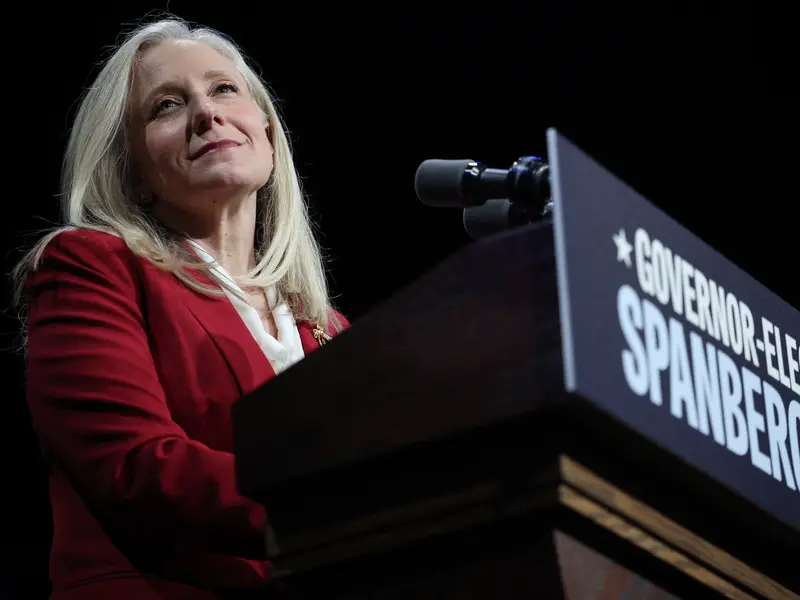
Democrat Abigail Spanberger has made history as the first woman elected governor of Virginia, defeating Republican contender Winsome Earle-Sears in a decisive race. With roughly 95% of ballots counted, Spanberger captured 57.4% of the vote to Earle-Sears’s 42.4%, a margin that underscores both her personal appeal and the broader political shift within the state.
Celebrating her victory before an energized crowd, Spanberger framed the election as a repudiation of hyper-partisanship. “We sent a message to every corner of the commonwealth… that in 2025, Virginia chose pragmatism over partisanship and stability over chaos,” she declared. Her win offers Democrats a symbolic and strategic boost after the party’s bruising loss in the 2024 presidential race, breaking a cycle of national setbacks with a significant state-level triumph.
Spanberger’s path to the governorship is unusually eclectic. Born in Red Bank, New Jersey, she moved to Virginia as a teenager and attended school in Henrico County before studying French at the University of Virginia. After later earning an MBA from Purdue University, she joined the U.S. Postal Inspection Service, where she investigated narcotics cases and other federal crimes—an early indication of her emphasis on public service over political ambition.
In 2006, she entered the Central Intelligence Agency, serving as a case officer focused on counterterrorism and national-security operations. That background, often highlighted in her campaigns, helped frame her as disciplined, pragmatic, and versed in global security—attributes that differentiated her from more traditionally partisan candidates.
Spanberger entered electoral politics in 2018 and won a seat in the U.S. House of Representatives representing Virginia’s 7th District. After three terms in Congress, she launched her 2025 gubernatorial bid, emphasizing economic issues and quality-of-life concerns rather than national ideological battles.
Spanberger rooted her campaign in promises to reduce the cost of housing, energy, and healthcare, positioning herself as a practical problem-solver. Her deliberate avoidance of inflammatory rhetoric—particularly her sparing mention of former President Trump—signaled her strategy to appeal to moderates, independents, and disaffected Republicans.
Her stance on immigration illustrates this balancing act. While critical of the Trump administration’s sweeping enforcement operations, which she labeled a “distraction of resources,” she avoided broad ideological attacks, instead arguing for more targeted and efficient policy.
Spanberger’s victory is not just a personal milestone; it signals a recalibration of Virginia politics toward the center at a time when both national parties are wrestling with internal divisions. Her disciplined avoidance of culture-war messaging may reflect a broader voter fatigue with polarization. However, the durability of her mandate will depend on whether she can translate her pragmatic brand into tangible improvements on high-pressure issues like housing affordability—an area where many governors have struggled.