
A severe bushfire outbreak in eastern and central New South Wales left a trail of destruction on Saturday (Dec 6), with around a dozen homes badly damaged or reduced to rubble as temperatures soared during an intense heatwave. The worsening conditions prompted authorities to close the M1 Pacific Highway in both directions, while more than 75 active fires continued to burn across the state. According to the NSW Rural Fire Service (RFS), most of the blazes were classified as “under control,” though 19 remained uncontained and unpredictable.
Australian public broadcaster ABC reported that as many as 16 houses may have been lost. Evacuation alerts were issued for residents in Koolewong on the Central Coast and Milsons Gully in the Upper Hunter—two of the hardest-hit communities. NSW Premier Chris Minns called the unfolding situation “very challenging,” acknowledging the emotional toll on families whose homes had been destroyed.
Six homes north of Sydney were confirmed burnt, with additional losses scattered across the state’s mid-north coast. One particularly large fire consumed more than 9,000 hectares (about 20,000 acres) inside Goulburn River National Park, underscoring how quickly conditions deteriorated.
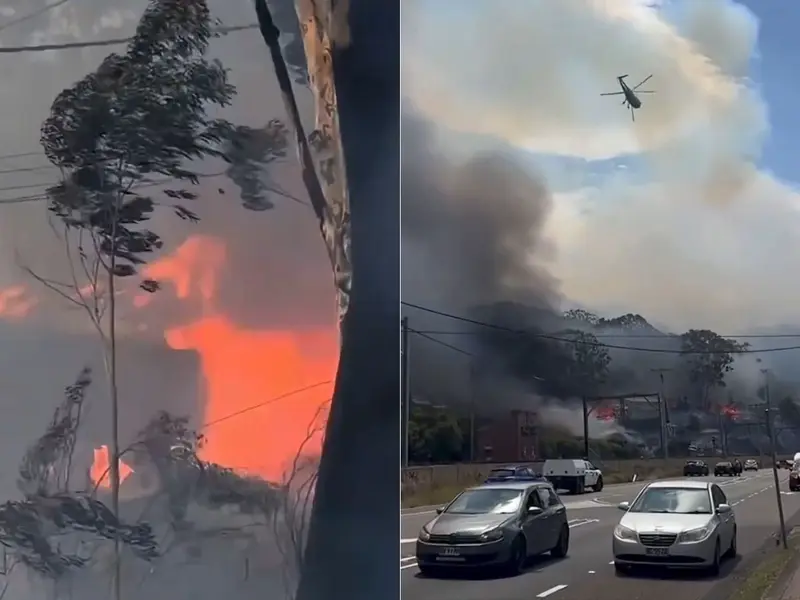
Minns said more than 1,500 firefighters and nearly 300 vehicles had been deployed in a state-wide effort to protect communities, stressing that residents must follow official instructions from emergency agencies. “We’re doing everything possible to protect lives,” he said, warning that people should stay alert and heed evacuation orders when issued.
RFS Commissioner Trent Curtin highlighted growing concern about a forecast overnight wind change expected between 2 a.m. and 5 a.m. Sunday morning—conditions that often cause fire behaviour to shift suddenly and become harder to control. He urged communities in at-risk regions to stay vigilant as crews prepared for what could be a difficult night.
Social media platforms filled with dramatic video clips showing fast-moving flames and towering smoke columns—images that quickly gained traction as the scale of the crisis became more visible.
Dean Narramore, a forecaster with the Bureau of Meteorology, warned that scorching temperatures driven by hot, dry winds were pushing many areas close to 40°C. He described the situation as “a dangerous few hours,” explaining that the combination of extreme heat and strong gusts was driving volatile, high-risk fire conditions.
While bushfires are a familiar part of Australia’s summer landscape, experts note that hot, windy days—especially during heatwaves—can rapidly transform small fires into large, fast-moving threats, particularly in sparsely populated regions where terrain is difficult to access.