Hundreds of South Korean nationals caught up in a U.S. immigration sweep arrived back in Seoul on Friday, closing a week of diplomatic unease and corporate disruption.
The group — 317 people, mostly men — flew in on a Korean Air charter from Atlanta after being detained in a September 4 raid on a Hyundai-linked site in Georgia. U.S. officials framed the operation as part of a probe into “unlawful employment practices.” While one worker chose to stay in the United States, 14 others employed by South Korean firms in China, Japan and Indonesia also joined the return flight.
At Incheon Airport, they were met by television crews, placards and applause — and by critics accusing Washington of “backstabbing” its ally. One banner depicted Donald Trump in an ICE uniform with the words, “We’re friends. Aren’t we?” The symbolism underscored how a single enforcement action can reverberate across public opinion and policy debates in Seoul.
The flight itself had been delayed a day after then-President Trump reportedly floated keeping the workers in the U.S. to train Americans for Hyundai and LG Energy Solution’s $4.3 billion electric-vehicle battery plant in Georgia. Seoul pressed for their immediate return and secured assurances they would be released without restraints, which officials described as a non-negotiable demand.
Hyundai later confirmed the battery plant’s construction will be delayed two to three months. The $4.3 billion project is projected to create 8,500 U.S. jobs, but Hyundai emphasized that none of its direct employees were detained; the 47 LG Energy Solution staff and others held were mostly subcontractors. LG publicly apologized, promising that those affected would not face penalties on future U.S. entries.
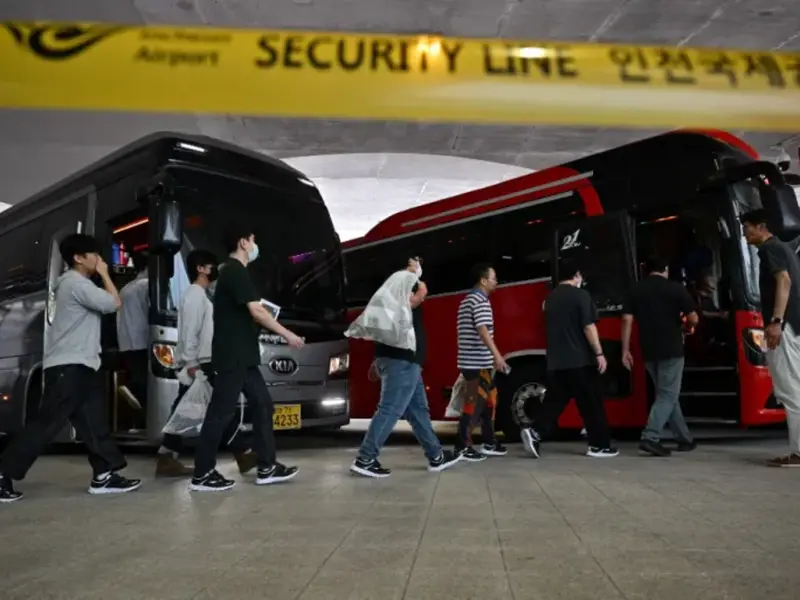
The episode exposes a long-standing grey area: South Korean workers on short-term business visas have long staffed big U.S. industrial projects with little scrutiny, but the Trump administration’s abrupt enforcement push has upended that practice. In Seoul, the raid has triggered a wider discussion about the risks of pouring capital into the U.S. despite a pledged $500 billion in investments — including $26 billion from Hyundai — linked to tariff negotiations. Officials warn that harsh treatment of temporary staff may chill future projects.
Meanwhile, about 145 workers from countries such as Mexico, Colombia, Chile, Ecuador and Venezuela remain in detention. Labour unions on both sides of the Pacific argue employers, not employees, should bear the fallout of visa missteps. “Capital must stop shifting the burden… onto the backs of workers,” the Korean Metal Workers’ Union and the U.S. United Auto Workers declared in a joint statement — a reminder that this dispute is not only about immigration enforcement but also about who shoulders risk in global supply chains.