Ukrainian President Volodymyr Zelenskyy says several countries, including the United States and partners in the Middle East, have requested Ukraine’s assistance in countering Iranian-made Shahed drones, reflecting growing international interest in Kyiv’s battlefield experience with the technology.
Speaking late Wednesday, Zelenskyy said governments across the region—including the United Arab Emirates, Qatar, Bahrain, Jordan, and Kuwait—had approached Ukraine to explore cooperation on defending against the drones. According to the Ukrainian leader, any support Kyiv provides would be contingent on ensuring that Ukraine’s own defensive capabilities are not diminished.
Zelenskyy said the potential cooperation could also support Ukraine’s broader diplomatic efforts to end Russia’s invasion. “We help defend those who help Ukraine achieve a just end to the war,” he said.
On Thursday, Zelenskyy stated that the United States had formally requested assistance related to drone defense in the Middle East. He said Ukrainian specialists and equipment would be made available but did not disclose details about the scale or nature of the support. In a message posted on social media, he added that Ukraine would assist partners who contribute to the protection of Ukrainian lives and security.
U.S. President Donald Trump indicated openness to international support, telling Reuters in an interview that he would consider “any assistance from any country.”
Since launching its full-scale invasion of Ukraine more than four years ago, Russia has deployed large numbers of Shahed drones against Ukrainian targets. Ukrainian officials say tens of thousands of the drones have been used in attacks, including a single night when Russia launched more than 800 drones and decoys.
Iran has also deployed similar drones in the Middle East following joint U.S. and Israeli strikes, increasing concerns about the proliferation of the technology across multiple conflict zones.
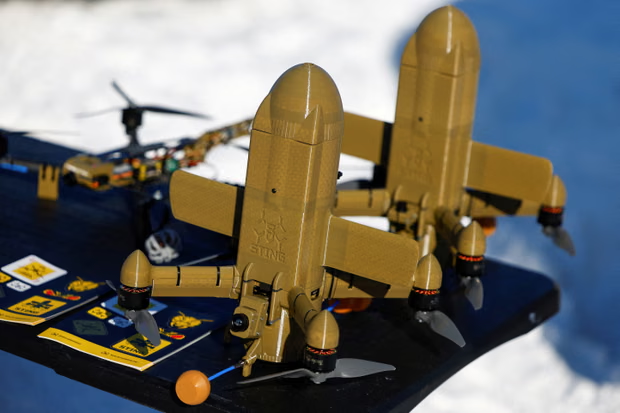
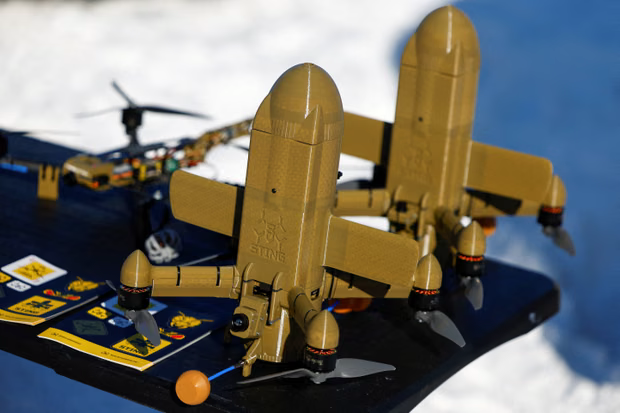
In response to the threat, Ukraine has developed a range of comparatively low-cost countermeasures. Ukrainian engineers and manufacturers have produced drone-intercepting systems costing as little as $1,000, as well as specialized interceptor drones designed to locate and destroy Shahed aircraft. The country’s rapidly expanding drone sector is now producing more equipment than is required for domestic use, according to officials.
The evolving threat from inexpensive unmanned systems has also prompted reassessment among European militaries. In September last year, Poland deployed high-value assets—including F-35 and F-16 fighter jets and Black Hawk helicopters—after low-cost drones entered its airspace, highlighting the challenges posed by relatively inexpensive aerial systems.
Earlier this year, Zelenskyy announced plans for Ukraine to begin exporting some of its combat-tested counter-drone technologies.
European Union foreign policy chief Kaja Kallas said ahead of a meeting of EU and Gulf foreign ministers on Thursday that Ukraine’s experience with drone warfare would be part of discussions on improving regional defenses against Iranian systems.
Meanwhile, escalating tensions involving Iran have diverted some international focus away from the war in Ukraine. Zelenskyy said the situation has led to the postponement of a new round of U.S.-mediated negotiations between Kyiv and Moscow that had been scheduled for this week.
“Because of the situation around Iran, there are not yet the necessary signals for a trilateral meeting,” Zelenskyy said, adding that talks could resume when security conditions allow.
Oleksandr Merezhko, chair of Ukraine’s parliamentary foreign affairs committee, accused Russian President Vladimir Putin of prolonging negotiations in order to continue military operations while avoiding additional U.S. sanctions. He also argued that conflicts in Ukraine and the Middle East should be viewed as interconnected due to cooperation between Russia and Iran.
“Russia and Iran are close partners acting together,” Merezhko told the Associated Press. “Iran provides weapons while Russia supports the development of Iran’s defense industry.”
On the battlefield, Ukrainian forces have recently made limited gains along parts of the roughly 1,250-kilometre frontline, according to the Institute for the Study of War. The Washington-based research organization reported that localized Ukrainian counterattacks in the final weeks of February recaptured more territory than Russian forces seized during the same period. It estimates that Ukrainian troops have regained about 257 square kilometres of territory since the beginning of the year.